The great Roger Day, one of my favorite children's music artists (click here for my previous feature on him), has released his third CD, called Dream Big!, and it adds several more Roger Day classics to the kids' music catalog.
Roger has a way of making memorable, easy to follow and also very musically fulfilling songs, and the first several tracks on Dream Big! are terrific examples of that, including the poppy title track with its enthusiastic exhortation for kids to sing loud, jump high and dream big; "Rumble in the Jungle (The Elefunk Song)"; the mid-career Beatles with string quartet sound of "Zachary Hated Bumblebees"; the laid-back charm of "I Like Yaks"; "Roly Poly", with a Buddy Holly/Bo Diddley riff that appropriately employs The Crickets as the backup band and has a hilarious line about not knowing "Bo Diddley squat"; and "Uno, Dos, Tres", with a catchy and beautiful Spanish melody.
The album is only hit-and-miss for me after that point. I give Roger mucho bravery points for his rapping on "Turn Off the TV" (my wife and I have instituted a strict "no middle-aged white guy rapping" policy for my albums). I'm not sure how well the song will work, but if you're trying to get your kids to watch less TV, I suppose it can't hurt. "Hello Sunshine" is nice in a Turtles meets The Osmonds kind of way, but also sort of innocuous (in a Turtles meets The Osmonds kind of way). "Zoe's World" would have made a perfect 80's sitcom theme. "Happy Hippos Hopping" and "The Greatest Day on Earth Day" sound very similar to each other, and remind me a bit of Ralph's World's more cutesy folk-pop songs. "Life is a Miracle" is a very engaging reggae anthem, and "I Love You (More than My Shoe)" is a fun old-style tune reminiscent of "The Goodbye Song" from Roger's last album, Ready to Fly.
The later songs that didn't grab me as much are still decent and well-produced by any other standard, so to say that they aren't as good as the earlier tracks or as some of Roger's other hits like "Mosquito Burrito" and "Open Up the Coconut" is not to say that they're not good. It's just that the bar has been set very high. Altogether, it's a really fun album, and it's great to hear some new music from Roger, especially considering that Ready to Fly was released waaaaaay back in 2001.
Mister Billy is a very popular children's entertainer from Wisconsin. He performs over 300 shows a year, which is an amazingly busy schedule for any performer, but especially for someone doing energetic live shows for kids. Obviously, he is great at entertaining kids in a live setting, but his CDs also stand up on their own, with a lot of great songs and energy, and a nice variety of styles and approaches.
Much of Mr. Billy's music has the feel of classic rock 'n' roll, and he appropriately rips on guitar, with many cool riffs on his songs. Vocally, he's got a twangy blues rock delivery, which can also be very expressive when needed. If I had to pick another artist that he reminds me of, it would probably be ZZ Top, ranging from their early raw music ("La Grange", "Cheap Sunglasses", etc.) through their more commercial later music ("Legs", "Sharp Dressed Man", etc.), and also on another end of the music spectrum, he's kind of like Howard Jones.
Mr. Billy has released four CDs, and while most of them are electric guitar-based, his latest album, Batteries Not Included, is all acoustic, though still with a lot of the same rock feel to it. It starts off with "Good Morning", which has a catchy and funky feel and includes a very nice counterpoint section. This is charmingly quirky and reminds me of my friend Kent Olmstead, who writes and produces cool indie rock with the band Fast Sundae. "Clap Your Hands" is a participatory rock anthem, which largely cops the "Satisfaction" riff at one point. "We Went to the Sea" chugs along nicely with an enthusiastic chorus of kids. By and large, Mr. Billy seems to be targeting the younger range of kids with these songs, and he does a really good job of appealing to their interest and attention.
Songs like "R-I-N-G-O" and "The ABC Blues" are kind of fun the first time for me and then don't really hold any interest beyond that, but kids would give them more longevity, and ultimately that's what matters. Other covers on the album are either hit or miss, and my definite preference for Mr. Billy's recordings are his original songs, which are very memorable in their own right. My favorites are in the middle of the album, starting with "Something Fishy", which is a take on the old "Teasing Mr. Crocodile" song and has a cool Grateful Dead with minor chord harmonies kind of sound. Next is "Chug-a Chug-a Choo Choo", a very catchy blues rock hit with an amazing sped up fiddle break (see video below). "I Heard Said the Bird" is a really fun 50's rocker a la Elvis and the Stray Cats.
The album closes with two more great songs. "Bernie the Bubble Breathing Dragon" has some terrific chord changes and a nice "don't play with fire" message. "Goodnight Sun" is a gorgeous lullaby. There is another Grateful Dead comparison here, but this time in the sense of some harmonies that don't quite lock in together. But just because the harmonies are a little off on "Box of Rain" or "Uncle John's Band" doesn't mean they aren't still great songs to listen to, and the same thing definitely applies for "Goodnight Sun".
I wanted to feature Mr. Billy and Monty Harper subsequently, because they have worked together on a few projects. The pair collaborated on both "Chug-a Chug-a Choo Choo" and "Goodnight Sun", and one of my favorite songs on Monty Harper's new Get a Clue album is "Can You Guess?", featuring Mr. Billy's arrangement and instrumentation. I also received Mr. Billy's Greatest Hits album, which includes a wider variety of styles and sounds, and features his electric guitar sound. "Seuss on the Loose" has that modern ZZ Top sound that I mentioned before. "The Ants in Your Pants Dance" is kind of like a cross between Huey Lewis' rock songs and "Hand Jive" from Grease, and is thankfully nothing at all like my own song of the same name (another example of what I said in my recent Idea Tree 2.0 post, that the same idea or title can yield totally different results). "First Day!" is partially a parody of "Summertime Blues" with a bit of a Scorpions riff and ably tackles the tough job of making the first day of school seem like a great thing. For some kids it is (and for parents, definitely), but for many a little propaganda like this might help ease the long walk out to the bus stop after the all-too-brief summer fun. "I Like Dinosaurs" has a really great riff and a B-52s 80's rock feel. "Let's Go Writing" has a bass riff that's kind of a fast version of "Peter Gunn" and a sweet vocal echo on the hook. "Bubble Trouble" goes some interesting directions and has very clever sound arrangement. "Don't Call Me a Bird" is a neat riddle with a Sting/Bon Jovi/Howard Jones flavor.
You can gather from some of my descriptions above that Mr. Billy is pretty heavily influenced by 80's music, running the gamut between 80's rock and metal and 80's synth pop and new wave. So that might be a determining factor as far as how well parents will take to his music. But regardless, kids will find a lot to love in Mr. Billy's songs, and they might be a good way to transition your kids into listening to your old Flock of Seagulls and Men Without Hats albums.
I'm happy to announce the release of Snail's Pace, my fourth CD of cool tunes for kids. I was about to say "my new CD", but it's actually somewhat of a compilation of the more laid-back tunes from my three previous albums, with six new tracks, so it's only partially "new". The new tracks include a new recording of "The Elephant Song", featuring my girls, Becca and Evee; "Scat Cat", which I've mentioned and previewed here before, featuring the amazing scat vocals of Sam Payne (and the "Scat cat!" yelling of some of you!); "Nightlight", a new version of a pre-kids' music song of mine (which was in the top 10 for quite a while on the old MP3.com charts); "For the Beauty of the Earth", a classic hymn; and my version of "Twinkle Twinkle Little Star", with some original lyrics and music. There is also a bonus download track included, called "The Cruelest Lullaby". (That was originally going to be the final track onMonkey Business, but we thought there was a chance that it might be too scary for some younger kids who wouldn't get that it's meant to be very tongue-in-cheek, so we rewrote it as "Rest Easy Now".)
Snail's Pace can be ordered at this page, and if you already have my first three CDs, there is a special deal available to only get the new tracks as a ZIP file or as individual downloads. Snail's Pace includes a bona fide lullaby or two, but it's really more of a "quiet-time" or "chill out" kind of album, and also has some spiritual undertones here and there. It was a lot of fun to put together and work on the new tracks, and I was able to do a few minor edits and mixing tweaks to some of the previously released tracks (which is always nice to do if you can find the time and reason to do so). I hope y'all enjoy it a lot.
I wanted to mention, also, that the cover of Snail's Pace was designed by my daughter, Becca, who was three at the time. Roseann and I were talking about what the title of the album should be, when Becca walked up with a picture of a snail that she had drawn on her magnetic drawing board. We quickly took a picture of it (those things aren't really the most permanent mediums of art!) and the snail on the cover of the album was taken directly from that original picture, though Roseann colored it and added some shading and did the background (with Becca's help).
I'm also happy to announce that the one year birthday of this blog was last week. I checked the stats recently and it has grown almost exponentially in readers since the beginning, so I'm really glad to see that. But although I know that a lot of people are reading the posts and articles here, I would love to see more commentary, so please feel free to add your thoughts.
It turns out that I've been averaging just over a post a week this past year. A post a week was my target goal, so that's cool, although it's probably seemed to be less than that with periods of inactivity here and there. I expect the average to go down a little bit again over the busy summer months, but I'll try to make up for it over the fall and winter. I do have a few new artist features and articles ready to go, so I'll be posting those every so often and adding whatever else I can when I have some free time.
Thanks so much for stopping by here and welcoming me to the kids' music blogging community. I look forward to sharing a lot more with you in the coming year!
Monty Harper is without a doubt one of the most lyrically sophisticated writers working in children's music today. He might be considered the kids' music equivalent of Stephen Sondheim. However, whereas Sondheim is often ribbed for not writing hummable tunes ("Send in the Clowns" the notable exception), Monty is also gifted with being able to create very memorable hooks and melodies.
Monty has six CDs of music for kids, and a while ago he sent me all but the newest one. I still haven't had a chance to listen to them all, so I'll focus my attention here on his live recording, The Great Green Squishy Mean Concert CD. I've heard that disc a few times already, and it is a really great collection of the different kinds of things that Monty does and does so well, and should certainly make a good jumping off point for anyone to check out his other work.
"Loose Tooth" starts things off with a catchy Buddy Holly vibe and some clever lyric lines like: I've got a loose tooth. I can't wait to surprise her when I tell my teacher: I'm losing an incisor. "Silly Song" is exactly that, with a catchy chorus that would be at home on a Barney video (and hey, say what you will about Barney, but it's hard to be that catchy). "Horny Toad" has a cool funky sound and tells you just about everything you might like to know about the creature. For example, when provoked, the horny toad squirts blood from its eyes. How cool is that?!
"Hanging Out with Heroes at the Library" reminds me of the kinds of songs that Eric Ode does so well... the music is good, it involves the kids' thinking and responding, and it plugs reading and libraries. "Pop Up Sit Down" is a fun song where Monty increasingly plays with the audience's expectations to great effect. "Love This Baby" is a cute take on the old "Shaving Cream" gag. "The Frog Song" is an interactive story about a prince looking for the perfect princess in every frog he sees. "You're a Dinosaur" is a rock song with a nice refrain that covers a number of popular dinosaurs. It goes on quite a while over several verses, but never feels too long.
"Big Red Fire Truck" seems a little ordinary, musically, until the chorus hits the line "See me race to the rescue" where it hits an incredibly awesome chord change sequence, which sounds particularly great with the fire alarm wailing over it. That little section alone makes that song a favorite of mine, and it's a good example of how Monty makes all of his songs interesting in different ways.
It's appropriate that Monty subtitled his first album with the phrase "Intelligent Songs for Kids". He definitely doesn't dumb anything down, and he isn't afraid to use big words, trusting that kids will either understand them or will want to learn them if they don't already know their meaning. And at the same time, his songs are fun and involving for kids and can work really well for a wide range of ages. In other words, you don't need to be a brainiac to appreciate Monty's songs, though it may help.
Monty's latest album is called Get a Clue, following the current Summer Reading Program theme that many libraries adopt. His last album, Paws, Claws, Scales & Tales was based on last year's theme. I believe that next year's theme is bug related, so I'm guessing that Monty may be hard at work on writing a number of bug songs. If songs like "You're a Dinosaur" and "Horny Toad" are any indication, not only will we learn a lot of cool information about bugs if Monty does a bug themed CD, but we'll also really enjoy the tunes while we're learning. Combining real educational content with memorably entertaining music can be a very hard thing to accomplish... Schoolhouse Rockis probably the best-known example of that... but Monty Harper is definitely a master of that in his own right.
Some fellow kids' music bloggers have recently posted what would be their "desert island" kids' music albums... the albums they'd most want with them if they were stranded on a desert island. I was going to make my own list, but realized that it would be hard to narrow that down to a number like 10 without leaving off something really great. And also, it is very likely that my list could change almost completely were I to be rescued and stranded again in a year's time.
So I thought perhaps it might be better to go right to the source... people who are actually stranded on islands... and see what kind of kids' music they're listening to.
Very interesting, indeed. And I'm sure Captain Jack Sparrow sang Captain Bogg and Salty tunes when he was marooned on a desert island before the first Pirates of the Caribbean movie, but I wasn't able to get visual verification of that.
So what are your desert island album picks, kids' music or otherwise??
Johnny Bregar (also known as Johnny Breakdown or Johnny Brady Are) is a super soulful Seattle singer and songwriter (how's that for some alliteration?) who manages to sound a lot like Dr. John, Harry Connick Jr., Jack Johnson, Taylor Hicks and Lyle Lovett, while still sounding very original. He has two CDs, both of which are incredibly upbeat, infectious and fun.
Johnny's first CD, Stomp Yer Feet!, focuses mainly on traditional kids' songs like "If You're Happy and You Know It", "B-I-N-G-O", "Polly Wolly Doodle", "This Old Man", etc. Like Little Nashville, Johnny has found a way to make each of these classics new and fresh while still retaining the spirit of the original. Johnny stays closer to the traditional kind of acoustic folk arrangements that these songs feel most at home with, but the playing is top notch and never gets dull, even though some of the songs go on pretty long (but hey, it's not his fault that "This Old Man" had to play all the way up to ten). And some tracks really spice things up with some great electric piano, organ, ukulele, banjo and other instruments.
Johnny's voice is very seasoned and belies his age (unless he's a lot older than he looks?), and he can carry some pretty heavy tunes with what seems like effortless ease. But it's the little details in his vocal phrasing that really sell his songs, like the cool way he says "uh huh" in "Froggy Went a Courtin'" or the gentle rasp that aches through "Toora Loora". And his version of "Waltzing Matilda" may have finally sold me on that song, which I was only kind of "meh" about before.
Hootenanny, Johnny's second CD, includes a few more traditional songs like "Five Little Monkeys" (done in a swinging Stray Cats style with some nice Harmon mute trumpet) and "Miss Mary Mack" (with a hoppin' Cajun backbeat), but focuses more on original songs, which are mostly in the same style as the tunes he covers. I'm not sure that his originals like "Blue Dog", "Best Friend", "Blackberry Pie" or "Owl" will become classics like "If You're Happy and You Know It" or "You Are My Sunshine", but they are very catchy and it's telling that they stand along so well on the same albums as those standards. The only thing that seems a little out of place is the song "Moon" on Stomp Yer Feet! It's a great song on its own, but the style is more modern and feels a little unusual among the rest of the traditional tunes on that CD.
I'm all for people doing something unique with their music and finding their own creative voice, and though Johnny Bregar's songs would seem to hearken way back to days of yore and territory that is oft-covered, I'm not aware of anyone else doing kids' music, traditional or otherwise, with his kind of style and soul. Bravo, Johnny!
So, I broke my arm last Tuesday saving a family of chipmunks from a giant grizzly bear. No, not really... I was actually arm- wrestling Arnold Schwarzenegger, and after I beat him I jumped up and went "woo hoo!" and slammed my arm into the ceiling. No, not really... I actually missed the landing when coming out of the back of a pickup truck while helping a neighbor move their new grill. But I was happy with how many kids at the schools I performed at this week chose the Arnold story when I gave them those options to choose from. Yeah, they know I could take the Governator...
I was a little worried when that happened as far as whether I'd be able to do my shows well enough in the coming weeks. Fortunately, The Invisible Band is versatile and able to cover for me on guitar for most songs, and I do have enough movement in my right hand to strum chords very feebly for a song or two each show, though I can't finger-pick like I usually would for things like "The Elephant Song". One problem is that I can't really clap my hands (well, I can but it hurts like heck and you can't really hear any "clap") or hold a leaky squirt gun or do a few of the other things that would normally be part of my show. Thankfully, my wife, Roseann, is a great costume designer and is willing to be a mascot performer when needed, and she happened to have a nice new rhino costume that we'd used for some recent school promotions, so she did a great job filling in and helping out. (Many thanks also to Rachel from the Auburn library for helping to watch our girls while Roseann was busy rhino-ing, and thanks again to SunWest Sportswear for the cool T-shirt for the rhino.) I'm not sure that the rhino will be able to appear for all of my upcoming gigs, but it did buy me some time to adjust my show as needed and gain a little more strength in the arm.
So I have to apologize again for the lack of updates here. I did have a list of new features ready to go including John Hadfield, Mr. Billy, Johnny Bregar, Monty Harper and Randy Newman. But then of course this happened and it's really tedious to type with just one hand, especially when that hand is your left hand and you're not left-handed. I did find a really cool voice recognition program online that translates your speech into text, so I'll be using that for the next while to get some things done. The program works really well but it does have to get used to your speech patterns, and it doesn't do the best job with things like people's names, so I have to go back and edit a few things. For example, here is what this previous phrase was supposed to be - So I have to apologize again for the lack of updates here. I did have a list of new features ready to go including John Hadfield, Mr. Billy, Johnny Bregar, Monty Harper and Randy Newman. And here's how the program translated that section - Zeile left of college as a gang for the lack of tape here any analyst and it features ready to delegate in John Hatfield Mr. Killeen Johnny breakdown money harbor and randy Manning.Actually, to be honest, that's what happened when Roseann did it... It has learned my speech patterns pretty well by now and so it got that part very close when I originally dictated it (the only differences were "Johnny Brady Are" instead of Johnny Bregar and "Mr. Bailey" instead of Mr. Billy). But her version was a lot funnier and indicative of how these programs can function until they learn your voice, or until you learn to slow down your speech and be very deliberate with your articulations.
Anyway, I have a lot to be grateful for, particularly that the injury wasn't worse... I landed on my back, but my arm slamming into the ground first broke the fall enough that my back didn't sustain the brunt of it. Also, when I was called to go help my neighbor, I had just been recording the final guitar parts for my upcoming album, so that can still go out soon without further delays. I have many supportive people and rhinos around me to make sure I can continue doing what I need to do. And I got this really awesome itch stick from the hospital. Ahhhhhh, that's the spot!
A few more thoughts to follow up my post from last week. Look for the second right answer... or trust the first.
One of my favorite "idea" persons is Roger von Oech of Creative Think. He's penned some really cool creative thinking books with great titles like A Whack on the Side of the Head and A Kick in the Seat of the Pants. One of the techniques Roger teaches is to look for the "second right answer" (or third or fourth right answer). We can sometimes find a good answer to a problem or discover a great new idea that might be perfectly workable, and yet, if we don't continue searching at least a little bit further from there, we might miss out on what might be an even better answer or idea.
I agree that looking for "the second right answer" can be a great tool for many creative and problem-solving applications, and I often have to employ that when working on lyrics, where a general sense of what I'm trying to say will come first, and then a better way to say it comes later. However, I find that when I'm creating music, my instinct is usually to go with the first thing that struck me when I was playing around on an instrument. There's something mysterious about music and why it works to create enjoyment, and for me it's almost a Tao kind of thing where I trust to follow whatever the flow is when I'm in the mode of creating something. I may spend a lot of time crafting and honing whatever it was that first came out, or making some adjustments to it, but more often than not I will keep at least some essence of what it was that came out initially.
Sometimes, once I've got part of a song together and I'm recording a rough demo, I'll be brave and continue recording into whatever part of the song I didn't have finished yet, completely ad libbing the chords and/or vocal part. At the time I'll think, ah okay, I'll have to come up with something better for that part later... but when I listen back, it often turns out that there was something about where I happened to go that was quite interesting and useable, perhaps with a bit of work. I might not have recognized it so much while I was actually playing it, but listening back later can give a totally different perspective. (It seems that the bridges of songs are quite amenable to that kind of thing... You can create bridges of all shapes and sizes that will work just great to transport your ears safely from the second chorus to the third verse.) That perspective of time and being able to get outside of what you're doing can be very important to appreciating the work (or not). There's a great story Jerry Garcia used to tell about how he once pushed Grateful Dead bassist Phil Lesh down a flight of stairs after a concert (yes, Jerry Garcia did that!) because he was so upset at how bad the band had played. But when he and the band listened back to the tapes later, they liked that show so much that they actually released it as a live album.
"Write what you know" and/or "make stuff up".
The old adage about writing is to "write what you know" and I agree that's often very useful; Scott Adams worked for years in cubicle-lined companies before creating Dilbert; Kurt Vonnegut was actually at the Battle of the Bulge that he wrote about in Slaughterhouse Five; and Charles Dickens grew up and worked among the wide cross-section of humanity that he wrote so colorfully about. But then again, Robert Plant was in Morocco when he wrote the song "Kashmir" and most of the Beach Boys never surfed. So I would say that "make stuff up" is also a good motto for writers, perhaps especially for songwriters. I suppose it's easier to get away with making stuff up when writing a song because you're only talking about as many words as might equal about a half of one page of the average novel. Novelists have a much more detailed story to describe and they should probably have a better idea of what the details of their story are all about.
But very few "true stories" are anywhere near 100% as they really happened, so writing what you know can always be combined with making stuff up. I've done that several times... "There's a Monster in My House" was based on a true story... not from me, but from my wife when she was little... though how the song turns out is made up. "Hide and Go Seek with the Moon" was based on how my girls are avid "moon spotters", but that idea was embellished from there. A musical I wrote called A Week in the Life (think The Office with singing and dancing) was based almost entirely on the company where I used to work in customer service, and I used several of my colleagues there as the characters and a lot of dialogue from things I'd noted over the years. But since the day-to-day work in that kind of company doesn't typically involve what we normally think of as "plot", I had to create and embellish a few concurrent plots involving some situations there, some of which had occurred and some of which only sort of happened. By the time the show ran I estimated that it was about 70-75% true to life, and the rest was either completely made up or embellished in some way or other.
When writing songs for kids, how much you write about what you know (or knew, or observe about kids) and how much you make stuff up depends to some extent on what kind of perspective you're coming from as the singer... Are you singing as a kid talking about his own life, or singing as a kid talking to other kids or telling a story to another kid, or singing as an adult to a kid, or singing as a pirate or some other character that is enacting a story for kids? I think Justin Roberts is an absolute master at writing from a kid's perspective, and Frances England does that amazingly, too. It's great not only for kids, who can relate so well to it, but it also helps you as an adult to appreciate a kid's world better. But then making stuff up will probably work better for songs that are more character or story based, or just meant to be purely imaginative or absurd.
Ultimately, I don't know that it really matters all that much if you write from your direct experience or just make stuff up, as long as there's something interesting about it. As Ginger Hendrix said so well in a recent article she wrote about writing lyrics for kids' songs: "Maybe the criterion I'm reaching for is just the word authentic. Is the song authentic or was it written to lure cd-buying parents into feeling like they’re teaching their kids something? I don't know about you, but most days I feel like my kids end up teaching me a lot more than I manage to teach them."
But then, some great kids' songs have lyrics that are really about nothing more than teaching something to kids, sometimes even in a very generic or by-the-book way. For example, perhaps the most popular kids' song of all time has these lyrics: "A B C D E F G, H I J K L M N O P, Q R S T U V, W X Y Z. Now I know my ABC's. Next time won't you sing with me?" Not really the most artful or authentic lyrics ever, and it's totally trying to push a concept on kids... but hey, it's great for what it is and kids love it, so to me that's great kids' music. I almost wonder if the new indie kids rock aesthetic is putting too much emphasis on music and lyrics for kids needing to be oh so artfully hip and brilliant all the time... That's stuff that adults care more about, anyway, and then again, a lot of lyrics for adult songs are pretty silly and insipid and are pushing messages, and yet we still love a lot of those songs, so why should we care if some kids' songs are like that? If we're always looking down our noses at all of those so-beneath-my-level-of-cool Barney-esque kinds of songs, we might be missing out on giving our kids the next great simple and timeless learning anthems like "The Alphabet Song".
The Idea Dream Team = Columbus, Van Gogh, Judge Judy and Joan of Arc.
Roger von Oech talks about the roles of the creative person being the explorer, the artist, the judge and the warrior. First, the explorer has to go out and search for the raw materials that could make up an idea. Then the artist takes those materials and molds them into something. Then the judge looks at that "something" and determines whether it needs more work, needs to be thrown out, or is fit to go forward. And if the idea gets the okay from the judge, then the warrior takes it and fights for its success out in the world. It's not always a linear process like that... sometimes all of those roles are being enacted concurrently, and sometimes what the judge determines gives the artist a new direction which gives the explorer something new to discover, so the process can work backwards as well.
To me, the explorer is always discovering things, no matter where he travels or whether he stays put in his easy chair at home... And it's not the explorer's job to have any thought about what is to come from his discovery, but only to recognize that there is some potential in that moment of discovery. A song of mine for an upcoming album is called "How Big", which began with a feeling my "explorer" had while watching a YouTube video that zooms into a single atom from the far reaches of the universe. Another song called "Heartbeat (The Stethoscope Song)" began when my explorer smiled and laughed while my girls were playing with a toy stethoscope and listened not only to my heartbeat, but also to my nosebeat and elbowbeat, etc. And the feeling inspired by my one year-old (at the time) prying me from my busy work one day by saying, "Daddy... come play!" (with her eyes like Puss 'n' Boots from Shrek) led to a song by the same name.
Of course, many things that the explorer thinks are noteworthy don't even get past the artist, much less the judge. The artist takes all of those little nuggets of possibility and tries to turn them into something more tangible. Sometimes that works, and sometimes not. The artist often has to mangle and warp and twist the basic materials to create something he is happy with. Sometimes my artist will spend an undue amount of time trying to make something workable that just isn't... but that's to be expected, because he's good friends with the explorer and doesn't want the explorer to feel like his discovery wasn't at least given a good chance.
I think many artists can give too much weight to their judge. And then again, if you've seen any of the Americal Idol audition shows, you know that some people don't give their inner judge nearly enough power to stop them from embarrassing themselves on national television. I don't think I need to elaborate on what the judge is all about, only to say that there are times when you have to remind your judge that absolute perfection is not really a viable option in art, and that sometimes it is okay to let things through that are a little rough around the edges.
One thing to be really wary of is paying too much mind to anyone else's "judge" when they make a judgement about your work, especially when it's still in progress. I'm not a huge fan of creating artistic things by committee, and so I adhere to the advice I was given when looking for feedback on my first musical and handed out scripts to several people whose opinion I valued... The advice was to completely ignore individual criticisms. One person, even someone whose opinion I respect greatly, or even someone who is hugely successful in the same line of work, might really dislike some particular thing about my work, but if I change that aspect of the work to please only that person, I might have just changed something that everybody else but that person would have liked just fine. Everyone has particular tastes and preferences, and one person's opinion about something in particular should never supercede the artist's vision and inspiration for the work. But if you get what seems to be a general negative consensus about something from several different people, then it is worth looking into. It's still not necessarily worth changing, though... sometimes the artist just knows best about their own work... but it's certainly worth sending back to your explorer and artist to look into.
The ancient Greek sculptor Polyclitus once did an experiment where he worked on two sculptures simultaneously, one in his private workroom and one in the room where he often entertained guests. Whenever someone commented on the viewable sculpture, Polyclitus would change it as they suggested. When both sculptures were finished and showed to the public, the private one was declared a masterpiece and the public one considered an artistic disaster. When asked how the two sculptures could be so drastically different in quality, Polyclitus answered, "Because I made this one (the private one) and you made that one."
The bottom line is that my judge, and the judges of the people that I've chosen to work with, are hard enough to get past for my artist, but my work is my work because of the particular back-and-forth that my artist and judge have with each other. If I listened to recommendations of other people, some of my most popular songs wouldn't even have made it to the album or been finished in the first place, and my musical wouldn't have been produced, etc. Or, what was released would have been less of my work and more of a work by committee (which of course created the camel while trying to make a horse). Not to imply any bitterness or disaffection for people who have criticized my work, either during its creation or afterward... that's certainly not the case at all... but only to emphasize that everyone has their own opinions, and the ultimate opinion concerning the value of my work and whether it's worth creating is the one I have of it. Heck, ninety-nine out of a hundred people might dislike a movie or song or book, but there might have still been some real value for that one person for it to have been created and released. And that one person may be me, the one who created it, but sometimes, that's enough to justify its creation and existence.
In my Thinking Outside the Box assembly program, there's a point when I play a brief game of Simon Says with the kids, at which point I hold up a picture of Simon Cowell. That always gets a laugh, but I make a serious point afterwards that there are a lot of Simon Cowells in the world, and when you are trying to think creatively and come up with new ideas, sometimes you have to be strong and brave in the face of all the Simons that you might encounter. That's one of the main jobs of the warrior, to stand tall in the face of opposition and to keep your idea alive not only in the world but also in your own heart and mind. You could have an idea that you think is really great and tell it to your very best friend and suddenly they become a Simon and say, "That's not going to work." or "That's dumb!" And they very well might be right... but they might not be. You might really know best about how great that idea is and what its potential is. It's not worth getting upset with a Simon or taking offense, though, because they might not be able to see the idea in the same way that you do, and some people just aren't good about evaluating the worth of ideas... they need to see things in a finished and concrete form to be able to appreciate them. And they might not know that there could be something very valuable for you to experience and learn as you work with that idea. But the world is full of hugely successful things that were initially rejected... the first Harry Potter book was rejected by dozens of publishers... the Beatles were turned down by many labels... etc. So keep that in mind as you send your warrior out into the world, and make sure that they are well equipped with perseverance, strength, faith, determination and some really thick armor.
I've enjoyed sharing these thoughts with you, and I'll compile some more for another "Idea Tree" feature sometime down the road. Please share your own thoughts and stories about how your ideas have come to you and how they came to fruition (or not). I would love to reference some other artists' experiences for the next installment.
It's time to grab a bushel basket and head back out underneath the ol' Idea Tree and see what's ripe for the pluckin'... As I said in the original "Idea Tree" post, I believe that ideas for songs (and other things) are available in abundance, and it's mostly a matter of our climbing up into the idea tree to look for them, or catching them when they fall, and then trying our best to turn them into a delicious idea pie. Of course, my original post didn't begin to cover all of the ways and means of how song ideas happen, or how the ideas themselves develop into actual songs (or not), so I thought I'd add some more thoughts along those lines. I'd also like to encourage other musicians, writers, artists, entrepeneurs, etc., to contact me and share about how your ideas came to you and/or how you honed ideas into something fully realized. I'll probably do an "Idea Tree III: Jason's Revenge" at some point, and I'd love to include some of your stories for that.
I'm going to break this up into two installments. Check back next week for the second part...
Symphony No. 9 for Bagpipes
Sometimes a song idea doesn't start out so much as a song idea, but an idea that seems intriguing in another sense, as in, hey, wouldn't it sound great to record a song using nothing but an orchestra of bagpipes (it probably wouldn't)... Or, gosh, wouldn't it be cool if I could somehow commemorate the founding of the first curling club in Loch Leven in 1668 (it probably wouldn't)... And so there isn't a song idea, per se, but the idea that intrigues you can help to lead you in some unique songwriting directions. For example, the sonic nightmare of a bagpipe orchestra is likely to create some interesting lyrical possibilities and story ideas, and deciding to do a song about the anniversary of the first curling club is going to challenge you to find a way to write something exciting about a subject that just isn't very exciting at all (no offense meant to curling fans, but let's face it, the sport is pretty boring to watch).
We were in Utah last year and caught a show by my friend, Sam Payne. Sam is an outstanding original singer/songwriter in the general vein of Bob Dylan, Sting and Bruce Cockburn, and he also happens to be an incredible scat singer. I'd seen him perform a couple of times before, but this particular time I had one of those intriguing ideas that wasn't so much a song idea, but a concept idea, where it was like, hey, wouldn't it be awesome if Sam could scat sing on a song of mine (it probably would).
I mentioned it to Sam and he said that he'd love to do it, so at that point, the idea became slightly more than just an idea... it could actually happen. (It's usually good early on in an idea's gestation period to make sure that it even has the potential to grow beyond that stage.) The problem was that we would have a very limited time when we would be able to record him while passing back through Utah, and we really didn't have the actual song idea yet, so we had no idea what to actually record... what tempo, what key, what chords, etc. We thought, well, we could just record him ad libbing a bunch of scatting and hopefully work it into something later. And what we ended up doing wasn't so far removed from that, though we did end up having the very bare bones of a verse for a song and some specific chords for Sam to scat over.
I suppose that any song could include some scatting, but since in this case the person scatting wasn't going to be the same person singing the song, then it seemed a little more appropriate for the scatting to have some specific kind of focus or to be representative of a character. So thinking in terms of character and thinking of words that might go with "scat" led to the phrase "scat cat", and then a picture grew from there of a downtown alley where a cat is meowing all night long (or in essence, singing and putting on a show). Most of the people who live there love him and his "singing", but there are a few people who have to get up early every morning and don't appreciate his late night vocalizations, so they yell out their windows, "Scat cat!" and the cat misinterprets that as an invitation to start scatting. We had no idea initially where that basic premise would lead or if we could even make a whole song out of it, but it was enough to go on to create a very rough demo of the first verse and give Sam some chords to ad lib over. He was truly amazing, recording several wonderful takes having never even heard the chord changes before, and so then we had the raw materials for what might become a song. From there it took a lot of mental and musical wrangling to figure out where to go for the bridge and last verse, but thankfully, we eventually found a cool way to resolve the story and finish the song. But for quite a while it was nothing more than a smidgen of a song with some great scatting included, inspired by an idea that wasn't really an actual song idea.
("Scat Cat" will be on my upcoming Snail's Pace album, available for preorder here. You can hear a sample of the first two verses below. By the way, if you want your voice to be on "Scat Cat", I'm still accepting submissions for about another week to add to the third verse for the final mix. Click here for details.)
It's all been done... woo hoo hoo... but so what?
One thing I did when I first had the idea involving the phrase "scat cat" was to Google it and see if any other kids' performers had done a song like that. Best I could tell, they hadn't, so that was good. (As it turns out, a recent episode of Noggin's Jack's Big Music Show featured a character named Scat Cat who sings a scatting song, but that came out months after my song was finished and the song is nothing like mine, thankfully.) But then again, so what if there had been another "Scat Cat" song already? Song titles can't be copyrighted, and as long as your inspiration for the idea was indeed your inspiration, then the odds are that it will be unique enough to be worth creating. Well, I mean, there's a point when public familiarity with a title sort of makes it off limits... It would be difficult to comfortably do a new song called "Stairway to Heaven" or "Bohemian Rhapsody" or "One Eyed One Horned Flying Purple People Eater" (I was really disappointed when I found out there was already a song with that title.)
Especially in the kids' music genre, there seems to be a number of general subjects that get a lot of attention, such as the alphabet, animals, pirates, opposites, cleaning up your room, imaginary friends, and the list goes on. But I've found that there is always a new and interesting way to approach the same general idea if you look hard enough for it and find your own take on it. I touched on this very briefly in the last "Idea Tree" post, about how Justin Roberts' "sock album" would be different than anyone else's. And I recently covered Little Nashville and Gwendolyn and the Good Time Gang, both of whom have a song that is a Red Light/Green Light game... which isn't just a similar subject, but an identical subject... and yet, each song is fun and cool in its own way. It's always great if you can find subjects to write about that haven't really been expressed before, but there's no reason not to cover some of the same subjects that have already been done if you can put your own stamp on them. There have been times when I've been looking for ideas for songs and I've thought, well, what kind of typical "kid subjects" haven't I covered yet? I realized recently that I haven't done an "alien" song yet, so I was going to start thinking about an idea for an alien song, but when I was going through a mental list of typical kid song subjects I had another idea that sounded even better... to do a song that combines several of those kid subjects together. So that's now in the works for an upcoming album. And that's a good example of one idea leading to another, and one "already been done" idea leading to something that hasn't been done yet, or at least, not as far as I know.
Slot Machine Lyrics
For me, creating the music is the fun part of songwriting, where you get to make noise and play with sound and arrange notes and chords into colorful shapes and textures. I hate to make all musicians everywhere seem less cool than public perception has granted them for so long, but in essence, we're all just interior decorators that use notes and sounds instead of fabric and furniture. (I sometimes have to chuckle at musicians who takes themselves so darn seriously, when I picture them in that sense.) But for lyrics you sometimes have to really think, and that can be like actual work! To put it another way... Writing music is like playing with a really awesome giant robot toy, and writing lyrics is like filling out the registration card and rebate forms that came in the box with the giant robot toy; you know you should do it and you know you'll get something good out of it, but it feels like much more of a chore to actually do. Then again, when lyrics seem to come with ease in a rush of inspiration, that is very cool, but that just isn't often the case for me. I can spend a lot of time, months even, poring over one or two lyric lines for a song... which seems strange when it's a song about something silly like a cowboy with a ridiculous name or a stink bug who insists that he doesn't smell... but to me there are few things that can jolt you right out of the illusion of a song quicker than a lyric line that is clunkily worded (like how the phrase "clunkily worded" is clunkily worded) or feels wrong for the character of the song.
Sometimes working on lyrics means sitting quietly with a notebook or driving somewhere with a voice recorder nearby and trying to think it out, and other times it means playing through the song and sort of scat singing along with the vocal melody until a word or phrase comes out that sounds good where it landed. My friend Steve Brown of the great "BNL meets Simon & Garfunkel" band Border Crossing defined this as the "slot machine method" of lyric writing, and that's a perfect description of it. The first time through, one thing might lock in, the next time through another, and before you know it, you've won the jackpot, especially if the words turned out to be, "Yesterday, all my troubles seemed so far away." Odds are, the whole song won't need to be done that way, but once you get a few key phrases in there and have more of a direction and context for the words, then you can usually finish it from there by thinking it out.
Speaking of "Yesterday", that is a great example of using "placeholder" lyrics, which is a common thing for songwriters to do. Placeholders are lyrics that don't necessarily mean anything, but fill in the spaces of the melody for the time being until you are able to get the real lyrics together later. The original placeholder lyrics for "Yesterday" went like this: "Scrambled eggs, ohhh baby, how I love your legs". And then there's the classic Homer Simpson placeholder for the song that practically wrote itself: "Baby on board, something something, Burt Ward." Much as I try to use "Burt Ward" when I can, my placeholders tend to be just "la la la"s or the like, which becomes confusing for my girls, who learn to sing the song that way from the early demos and then at some point are surprised to hear that actual words were added and they have to relearn everything. (I suppose that "la la" would be easier to replace in your memory than "Burt Ward".) I once had a placeholder for the chorus of a song that went "blah blah blah blah", and for the longest time I couldn't get any actual lyrics in there, and then I finally realized that those were really the perfect words as it was, because the rest of the song was about someone who kept asking for advice but never listened to any of it, so it pretty much all ended up sounding like, "Blah blah blah blah". It made for an easy to remember hook and the song became a favorite back when I was playing the coffeeshop circuit in Western New York.
Well, duh...
I have a lot of "well, duh" moments like that when I'm writing songs, where I'll be banging my head against the wall about some lyric or some musical part, only to realize there was an obvious answer all along. One catch phrase that I try to remember is, "If you're looking really hard for something, it's probably right in front of you." The chorus for "There's a Monster in My House" (listen below) goes "There's a monster in my house, and it's coming after me. There's a monster in my house..." And then there's a little chord sequence repeated from the intro of the song. For a long time I kept thinking there needed to be a fourth line to go over that chord sequence which would rhyme with the "coming after me" line. I tried all kinds of things but only ended up with piles of crumpled up paper in my brain. And there are a lot of things that rhyme with "me", so it was particularly frustrating that I couldn't come up with a good line there. Then at last I had the "well, duh" moment I needed where I realized, hey, maybe it doesn't even need another line there at all. These are the little battles and discoveries that are all in a day's work for songwriters. I have habits and expectations for phrasing and vocabulary, both musically and lyrically, that I can glomp onto for certain songs or sections of songs, and sometimes it can be very difficult to step outside of those and see that there was something better right in front of me all along.
One more example of that is "No Big Deal" (listen below), which my wife, Roseann, and I collaborated very closely on. We had the music down and had a direction for the lyrics to basically be a "don't sweat the small stuff" kind of thing, and as we were working on the words we were wondering what the hook and the title would be. We kept saying things to each other like, "Yeah, it should be about how that kind of stuff is really no big deal, you know?" "Yeah, exactly, it's no big deal." "Right, but what should the title be?" "Hmmmm..." That went on for a while, far longer than I'd like to admit, and then... Can I get a "well, duuuuh!"
Check back next week for the next installment, The Return of the Return of the Son of the Bride of the Idea Tree.
A while ago, Melissa Block from NPR wrote an article about kids' music (click here and scroll down the page to read the article) that made me pause and wonder... The first paragraph said: "I'm the mother of a 4-year-old girl, so I spend a good amount of time in the company of kids' music. And I've become pretty choosy. I don't have a lot of patience for music that panders to what I consider to be misguided notions of what adults think kids must like. Excessive goofiness? Out. Phony silly voices? Out." I read that and thought, kids don't like goofiness or silly voices? Huh?? Having two young girls myself (ages 4 and 2), and having played shows for thousands of kids, one thing that I continue to observe on a daily basis is that kids love to be silly and goofy, even excessively so, and they also love that in their entertainment. In fact, if they love something silly and goofy, then they'll often love it again and again and again and again. If anybody likes goofy and silly things excessively, it's kids. I'll readily agree that goofiness and silly voices do not necessarily make for good kids' music; there still has to be some quality and charm to the "goofiness". And silly voices need to have character to them and be "cast" well to fit with the content of the song. And certainly there is a lot of room in kids' musical palettes for all kinds of other kids' music that is more straightforward or even serious... But to imply that it is a misguided notion that kids like goofiness or silly voices? Well, that's a very misguided notion to me.
The timing of that article was good, though, as it coincided with my receiving some CDs by longstanding children's music artist, Barry Louis Polisar. Barry has been creating and performing kids' music longer and more consistently than anybody else I am aware of (his first kids' music album came out in 1975), and he has been more successful doing that than just about everybody else in the field (over 350,000 units in print), and a lot of his music definitely falls into the goofiness/silly voices category.
Barry sings about and celebrates the way that kids are, not the idealized way that grown-ups want them to be. And a really great thing is that he lets you know up front what he's all about. His albums have titles like: Naughty Songs for Boys and Girls, Off-Color Songs for Kids, Stanley Stole My Shoelace and Rubbed it in His Armpit and Other Songs My Parents Won't Let Me Sing and Old Enough to Know Better: The Worst of Barry Louis Polisar. If you're a parent and you see a title like Naughty Songs for Boys and Girls, you should know the kind of music that's on there. Barry's music will not be every parent's cup of tea, and there are probably some kids who won't take to it, either, especially if they're used to less provocative kinds of kids' music. And I wouldn't play his songs yet for my girls... they're too young to appreciate it. But I think that most elementary school kids will find a lot to love and laugh at in Barry's songs, and Barry speaks to that audience like no other.
Sure, some of Barry's songs may seem kind of obnoxious on the surface, but a lot of them work on a level that is more than just obnoxious. For example, "Don't Put Your Finger Up Your Nose" is some darn good advice. And there are quite a lot of his songs that might seem to be a little unsettling at first until you hear how they resolve. A good example of that is "When Suzie Sneezed" from the Old Enough to Know Better CD, where the first verse goes: A friend of mine came by last night / Said, "Come on out and join the fight / Between Robert and Richard and Susan and Jimmy / 'Cause they just started beating up Timmy / 'Cause Timmy hit Billy who just hit Steve / When Steve hit Laura after Jack and Johnny / Hit Tommy and Richard hit Emily / Who accidentally pushed Debbie when Suzie Sneezed." The first time I heard that, I was thinking, is this really a kids' song about a fight club?? And it builds up in the second verse, escalating to tanks and guns. But it starts to change in the third verse: So I said, "What would happen if you tell Jimmy / You're sorry you hit him and that he hit Timmy. / Maybe Timmy would go and shake Billy's hand / Hopefully some day, they'll understand. And it continues on from there with the one kid trying to convince the other not to keep fighting, so it ends up being a great message about how misunderstandings can escalate into all kinds of craziness, but how at some point you can turn things around with an apology or a kind gesture.
"I Don't Brush My Teeth" may initially seem to glorify slovenliness, but it becomes clear that the protagonist suffers socially from his habits. I can imagine sensitive parents thinking that "Never Cook Your Sister in a Frying Pan" is giving kids all kinds of terrible ideas for how to hurt their siblings, but the final verse reveals its skewed take on the Golden Rule. And a song like "I Don't Wanna Go to School" seems rebellious until you get to the great punch line at the end. Barry's work is loaded with that kind of thing... He's really quite brilliant at playing with expectations, and kids definitely like to have their expectations played with when they're being entertained. Heck, probably 80-90% of all comedy is merely setting up an expectation and doing a twist on it. Not that it's easy to do well, though, and Barry is definitely a master in the vein of Shel Silverstein when it comes to that. And like Shel, Barry has the ability to turn some very clever phrases, such as the "stereotype" line from "That's What Makes the World Go Around": Some folks jog, some smoke pipes / Some are mono-toned, some are stereotypes / Right side up or upside down / That's what makes the world go 'round.
Barry also has a number of regular songs, without any twists or turns or controversial subjects or titles, and they can range from being quite sweet to very funny, such as "I Need You Like a Donut Needs a Hole", "I Miss Grandma" and "I Wanna Be a Dog" (which has been covered by several other kids' musicians... and should not be confused with Iggy Pop's "I Wanna Be Your Dog"). There are also some terrifically poignant songs like "Mom and Dad Are Always Right", which shows a kids perspective on parents who are always critical: Dad says he was stronger when he was half my age. / Mom never got dirty when she went out to play. / I guess they both were perfect kids when they were young like me; / They always did what they were told and that's how I should be.
Barry does a lot of silly character voices throughout his work, but even his usual singing voice might be considered kind of cartoonish as it is. It's definitely not the most polished voice, and yet it has an exuberance that works great for his material. You get the sense that he really is the kid whose point of view he's often singing from, who eats a bit too much sugar cereal and is trying to make the best of understanding his world. Fans of the Violent Femmes should like Barry's voice, as it's very similar in tone and phrasing to Gordon Gano, and Barry's music is often somewhere in the neighborhood of the Violent Femmes and John Prine.
I asked Barry if kids' tastes have changed over the last thirty years. He said that adult sensibilities change over time, and he's been around long enough to watch the styles of kids music go left, then right, then left, then right again, but that is probably more about the adults' tastes than anything... Kids have remained constant—laughing and giggling at the same things they did years ago. So it's no wonder to me that kids have made Barry so popular for so long. Barry speaks with their voice, and sometimes that voice is a very silly and goofy one, and kids love it. As opposed to advocating bad or obnoxious behavior in his songs, Barry is really making fun of it and trusts that kids can tell the difference. On his website, he says, "I have used my writing to hold a mirror up to kids, bringing things out in the open where they can be laughed at rather than swept under the rug." Elementary school is often the last chance for kids to really be kids and laugh at themselves and allow themselves to be goofy and silly without being so self-conscious, before things start getting a lot more mixed up and tense in middle school and high school. So I say, and I'm sure that Barry would agree... until that time... Excessive seriousness? Out. Barry Louis Polisar website
I should probably say up front that country music is not my forte, in any sense. It's not that I don't like country music... in fact, I like a lot of country music that I hear, but the thing is... I just don't hear a lot of country music. And I suppose that although I like a lot of the country music that I hear, I typically don't like it enough to really want to hear much more than I do, or to actively seek it out. Then again, there's a lot of sort-of-country-music that I've really been into over the years, including The Allman Bros., Johnny Cash, BR5-49, Neil Young, The Grateful Dead, Lyle Lovett, Chris Isaak, John Mellencamp and others. I also went to a Garth Brooks concert once in Buffalo when I was offered free tickets, and had to admit that I had a really great time and gained a much better appreciation of Garth as a performer and songwriter, and also for country music as a genre. I've also been caught inadvertantly singing along to country-ish songs like "Man, I Feel Like a Woman" (hey, it's super catchy... what can I say? Um... I trust that everyone who reads this will keep that to themselves...) But regardless, I still don't think I would typically choose to buy a ticket for a country music concert, or buy the latest Dwight/Toby/Keith/Alan/Kenny/Carrie album.
I guess what I'm trying to do here is to paint a picture that country music isn't really my thang, and I probably should have just said that to begin with and left it at that... But I also wanted to temper that by saying that once in a while I can appreciate it. And that's the setup I'm trying to give here, because I want it to have as much impact as possible when I say that the Little Nashville CD really blew me away. This is one terrific album of music, and I think it even transcends its genre. Like when you hear Bob Marley, it's great music, as opposed to just being great reggae.
I'm going to have some difficulty comparing things on this CD with other country artists or sounds, without having a great knowledge of the difference between Dwight, Toby, Keith, Alan, Kenny and Carrie (well, the difference between the guys and Carrie, yes...), so I may not even try. I can imagine a country music fan reading this and thinking, "He said that song sounds like Kenny Chesney, but it's totally an Alan Jackson thing." But I'll do my best to paint the picture.
The album kicks off in fine style with the upbeat "Welcome to Little Nashville", which immediately lets you know what you're in for. The production is great, and the guitar playing and singing by J. Juliano (or Sheriff Jay Hawke) is top notch. Again, a real country fan might know better, but from what country music I've heard, Jay's singing and guitar-playing is as good as anything I've ever heard in the country genre. I know Vince Gill is an amazing guitarist, and Jay's playing sounds as sharp and confident as Vince's.
Next up is the rollicking fiddle standard, "Turkey in the Straw", which is bound to elicit laughter on the "running down the street with a bear behind" line. The CD also covers several kid classics including "You Are My Sunshine", "I've Been Working on the Railroad", "The Hokey Pokey" and "Itsy Bitsy Spider", all done in a uniquely vibrant country style, and each with a different feel to it. "The Hokey Pokey" for example, is in the style of "Achy Breaky Heart", and in fact, it would seem that Billy Ray sort of ripped off "Hokey Pokey"... the chords are exactly the same and there's the similar hokey/pokey, achy/breaky wording. "I've Been Working on the Railroad" has a fast paddleball kind of sound and really cooks. I also like the vocal phrasing on "Dinah blow your horn". These songs retain the essential feel and qualities of the original, but deliver them in fresh and exciting ways.
There are some originals, too, and two of them in particular are really terrific. "A Little Different" is a whistling acoustic ballad that reminds me of the Motel 6 "we'll leave the light on" music. The song is very memorable, with some unexpected but perfect chord changes, and there's a cool message about accepting others for whoever or whatever they are. A square said to his Momma, "I saw a circle in town. You know how we've got these four sides? Well, he's just big and round." Momma Square said, "Let me explain... You're a shape, and he is, too. Hey hey hey, it's okay if he's just a little different than you." It's a simple, cute story and brilliant for the picture it paints.
The other original standout is "Like Mommy and Daddy", which is a really sweet country pop duet between Jay and Rosanna Spencer (aka Miss Laura Lee Goodheart). The voices complement each other beautifully and the song is both very catchy and very touching as kids describe how they want to do things just like their parents. It reminds me of a quote I read recently by James Baldwin: "Children have never been very good at listening to their elders, but they have never failed to imitate them."
The Little Nashville folks sent me a CD with a few songs previewing their upcoming album, and there are more great things in store. "Green Light" is another Red Light/Green Light game song, but is totally different than Gwendolyn and the Good Time Gang's "Red Means Stop", and goes to show how the same idea can yield many different variations. "That's My Dog" is a very catchy pop song that could be a big hit on the country stations, at least musically speaking... I'm not sure if kid-themed lyrics are ready to break through on the pop or country charts just yet.
I wonder if people who are into the new era of kids' music but who have no taste for country music are going to give this a chance with their kids. I certainly hope so, because it's such a standout in the kids' music field, its particular genre notwithstanding. There should be no question that Little Nashville will be a hit among kids and families that already have a big appreciation for country music, but it should really transcend that label, and I hope it is embraced by others like me who aren't really into country music all that much. I still have no real desire to turn on a country music station or to go and buy a Toby Keith record, and yet I liked this so much that I immediately wanted to listen to it again after it was over, and have done so several times since. It's kind of like the old Life cereal commercials, where they didn't expect Mikey to like it so much... Well, go ahead and call me Mikey, 'cause this is some really tasty stuff. And if Mikey likes it, then you might, too.
So I said in my last post that I was going to get caught up on all of the CDs I've been sent during the last few weeks while I was on the road. Well, you've heard about what happens to the best laid plans, right? A few days into the trip, my 4 year-old daughter put a CD (Gwendolyn and the Good Time Gang, one of her current favorites other than the usual "daddy songs") into the CD player. No problem with that, right? There wouldn't have been, except that there was already another CD in the player at the time... and it's not a multiple disc player. So we ended up being without tunes for a while there, and I was too busy with shows to stop anywhere to get it fixed until a few days ago.
But in the first few days of the trip and over the last few days I was able to listen to some discs, so there will be some new updates arriving shortly, including features on John Hadfield, Mr. Billy, Little Nashville and Barry Louis Polisar. And I still have a big stack of CDs to get to, so there should be more coming soon, though I'm not going to make any promises this time!
As for the Colorado trip, it was a really great time. There were so many incredibly enthusiastic audiences, and I can't wait to go back as soon as I can. I will be sure not to schedule so many shows together like that, though. It had been a few years since I've been to Colorado and I forgot how the altitude can affect your energy. I was halfway through my first song on the first day when I thought to myself, "Uh oh." But thankfully, I was well stocked with Powerbars and made it through okay.
I think that there is some kind of magical "show must go on" power that invigorates performers. There have been times in the past when I've been really sick or exhausted and felt like I could barely move, and I had to really force myself to make it to the show at all, but once I got out to actually perform, I felt fine, or at least, fine enough to do the show alright. And then, once the show is over, the tired sickness comes right back, but there's some kind of adrenalin thing that makes it work out for the show itself. I know other performers have told me the same thing. Knock on wood, but I can only recall one time in my life when I had to cancel a show for being sick, when my voice was completely lost from laryngitis and hadn't come back at all the day before the show. I hated to cancel, but I felt like I needed to give the venue enough warning to find someone else. And as it turned out, there was a rockslide on the interstate the next morning when I would have driven out there, so I probably wouldn't have made it anyway. Perhaps my body somehow knew that and said, "Ah, forget the show-must-go-on thing... you're staying in bed, dude."
Anyway, stay tuned for some new posts, and also Part 2 of The Idea Tree, which I've been working on here and there.
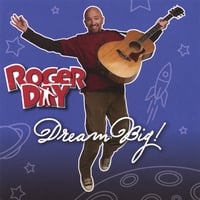 The great Roger Day, one of my favorite children's music artists (click here for my previous feature on him), has released his third CD, called Dream Big!, and it adds several more Roger Day classics to the kids' music catalog.